
Pressure tank replacement: warning signs and what to expect
By Bonner County Well Repair Guide Editorial Team · Updated 2026-09-22
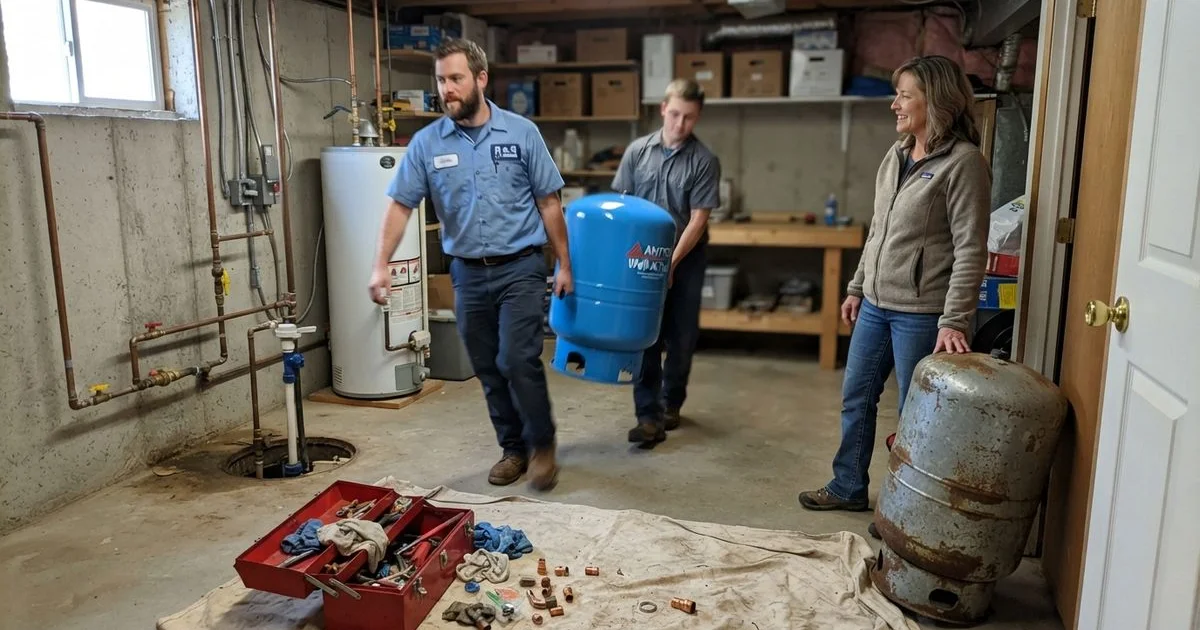
This is general information, not professional advice. Pressurized tanks and household electrical connections are best handled by a qualified provider.
The pressure tank is the quiet part of a well system. When it works, you forget it exists. When it fails, the pump starts to short-cycle, pressure feels uneven and your electric bill quietly climbs. Search interest in tank replacement is solid in this area, and the question behind it is usually the same: is it the tank, and what will the visit involve?
Signs the tank is the problem
A tank holds water on one side and compressed air on the other, usually separated by a rubber bladder. Trouble tends to show up as:
- the pump cycling on and off every few seconds
- surging or pulsing pressure at the faucets
- water or air spitting from the tank’s air valve
- a tank that sounds dull and feels full all the way up when tapped, which suggests it has become waterlogged
- rust streaks or dampness around the tank base
Any one of these can have another cause, so treat them as reasons to book a diagnosis rather than proof. Uneven pressure has other possible causes too, and the low water pressure from your well guide covers them.
Recharge, repair or replace
| Situation | Typical outcome | Why |
|---|---|---|
| Air charge slightly low, bladder intact | Recharge | Air can be restored with a gauge and compressor |
| Bladder torn or leaking | Replace | The air and water mix and cannot be separated again |
| Tank body rusted through or leaking at seams | Replace | Corrosion cannot be repaired safely |
| Tank is old and the pump is also tired | Discuss replacing both | One visit can address both, which some owners prefer |
If your pump is also on its last legs, our service pages cover the combined job, so this guide stays on the tank itself.
What the visit looks like
- Diagnosis. The technician checks the gauge, tests the air charge with the system drained and looks at the switch and plumbing.
- Shutdown. Power to the pump is turned off and the system is drained so the old tank can come out. Your water will be off during this time.
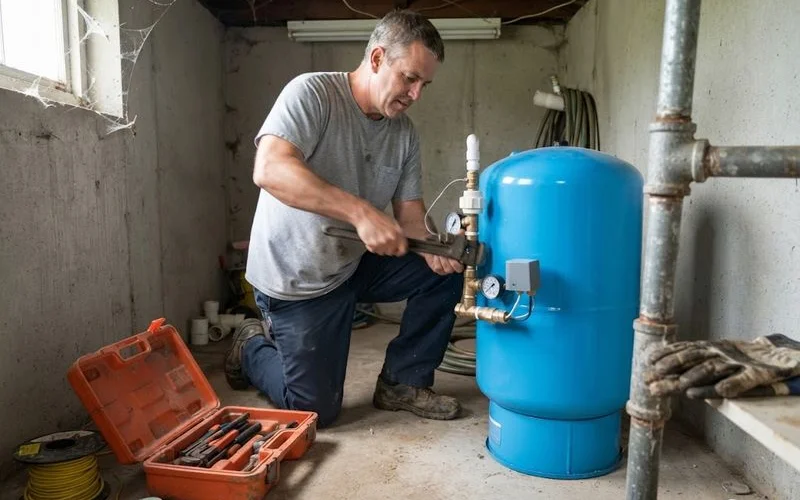
- Swap. The old tank is disconnected, the new one set and plumbed, and fittings and the pressure gauge are replaced if worn.
- Charge and test. The new tank’s air charge is set to match the switch’s cut-in point, then the system is refilled and watched through a few cycles.
- Walkthrough. A good crew shows you the gauge, explains settings and tells you what to watch for in the first weeks.
Questions worth asking
Ask which tank size and type they recommend for your household and why. Ask what the warranty covers. Ask whether the pressure switch and gauge are being tested or replaced, and whether an old pump is likely to be affected by the change. A tank that is too small will cause the same short cycling you started with.
Reviewers of local companies often say that crews explain a problem before fixing it and that quotes were laid out before work began. That is their reported experience, and it sets a reasonable bar for what to expect from a visit.
Planning around the outage
Water is off for the duration of the swap. Fill a few containers beforehand, plan around laundry and showers, and ask when the crew expects to restore service. If your system feeds livestock or a business, say so when you book.
When you are ready to compare companies, start with pressure tank and water system repair providers. Our methodology explains how listings are scored, and the home page has the full directory.
FAQ
- How do I know my pressure tank has failed?
- Common signs are a pump that turns on and off every few seconds, pressure that surges, water coming out of the air valve, or a tank that feels heavy and full when tapped. A technician can confirm with a pressure check.
- How long does a replacement visit take?
- Many straightforward swaps are completed in part of a day, but access, plumbing condition and tank size change that. Ask the provider for an estimate of time on site and when your water will be off.
- Do I need to replace the pump at the same time?
- Not automatically. A failed tank can be the whole problem. Still, ask the technician to test the pump and switch while on site so you do not discover a second issue next month.
- Can a tank be recharged instead of replaced?
- Sometimes a lost air charge on a healthy tank can be restored. If the internal bladder has ruptured, recharging will not hold and replacement is the normal route.